
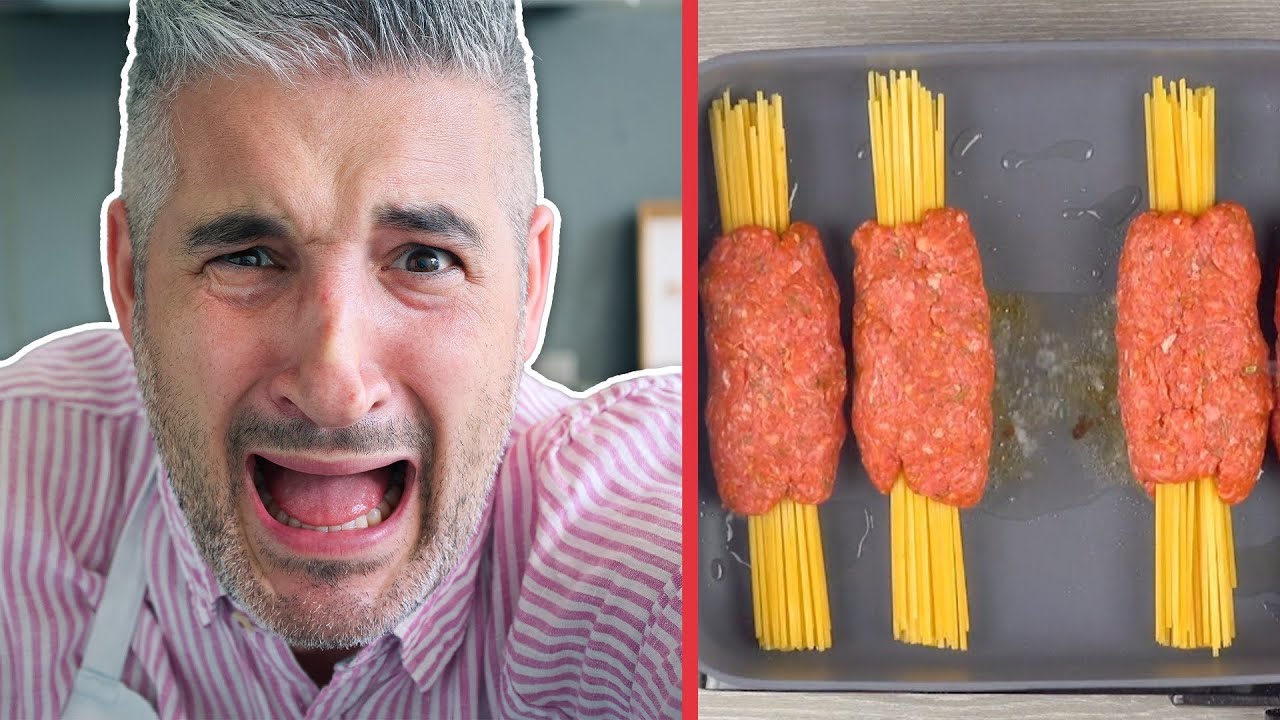
Listen, I need to tell you something. I broke spaghetti in half last Tuesday. In my own kitchen. On purpose.
And you know what? I didn’t even feel bad about it until I remembered that somewhere in Italy, a nonna probably clutched her chest and whispered a prayer for my soul.
Here’s the thing about pasta trends on the internet: they’re basically designed to make Italians lose their minds. And honestly? It’s become a whole genre of content.
There are entire TikTok accounts dedicated to filming Italian family members’ reactions to American pasta crimes.Like this guy who filmed breaking spaghetti in front of his Italian grandfather — the look of betrayal? Chef’s kiss. (The irony of that expression is not lost on me.)
But this isn’t just about broken spaghetti. Over the past few years, we’ve witnessed a parade of viral pasta trends that have sent Italian food purists into absolute spirals.
We’re talking pasta chips. Baked feta pasta that caused actual feta shortages. One-pot pasta that goes against every Italian cooking principle. And don’t even get me started on what people have done to carbonara.
So let’s talk about it. Because if you’ve spent any time on food TikTok in the last three years, you’ve definitely seen at least one of these trends.
And if you’re Italian (or Italian-adjacent, or just someone who cares deeply about pasta), you’ve probably experienced some light chest pains while scrolling.
The Crimes Against Pasta: A Greatest Hits
Breaking Spaghetti: The Gateway Drug
Let me paint you a picture. It’s 2020-something. You’re scrolling TikTok.
Suddenly, you see a video of someone snapping a handful of spaghetti in half before dropping it in boiling water. The camera pans to their Italian grandmother, whose face registers the kind of horror usually reserved for true tragedies.
This became a thing. Not just people breaking pasta (which, to be fair, plenty of us have been doing quietly in our own homes for years because not everyone owns a pot tall enough for full-length spaghetti and also, who cares?), but people specifically filming themselves doing it in front of Italian relatives just to capture their reactions.
The hashtag #breakingpasta has gotten millions of views. There are compilation videos.
There’s even a t-shirt that says “You break spaghetti, you break my heart,” which is honestly kind of adorable.
But here’s why Italians are so upset about this: In Italian cooking tradition, long pasta is meant to stay long. The whole point is that you can twirl it around your fork.
Breaking it? It’s not just practical laziness — it’s destroying the intended eating experience. Which, okay, I get it.
But also, my pot is 8 inches tall and spaghetti is 10 inches long, so something’s gotta give.
Here’s a compilation of Italian family reactions to broken spaghetti that will either make you laugh or make you very uncomfortable, depending on your relationship with pasta rules.
Pasta Chips: When Pasta Became a Snack Food
Okay, so in 2021, someone looked at pasta and thought, “You know what this needs? To be deep-fried and eaten like Doritos.”
I’m not making this up. The pasta chip trend took off like wildfire.
People were boiling pasta (usually rigatoni or bowties), coating it in oil and seasonings, then either air-frying or deep-frying it until it was crispy. The hashtag #pastachips racked up almost 600 million views. SIX HUNDRED MILLION.
Even Olive Garden tried to capitalize on it with something called “Italian Nachos,” which is exactly what it sounds like and exactly as confusing as it sounds.
The Italian response? Let’s just say I saw a comment that read, “This reduced me to tears,” and they weren’t tears of joy.
Because here’s the thing: in Italian food culture, pasta is pasta. It’s not a vehicle for becoming something else. It’s not a crispy snack. It’s pasta.
But you know what? I tried them. (I’m sorry, Italian internet, but I had to know.) And they’re… fine?
They’re basically crunchy, and you can dip them in marinara, and it’s not terrible. But it’s also not good in the way that actual pasta is good.
It’s just… a crunchy vehicle for ranch dressing, if we’re being honest.
The Washington Post even did a review and called them “a mediocre mess,” which feels about right.
Watch someone make them here, if you must.
Baked Feta Pasta: The One That Caused Shortages
Here’s my confession: I actually made this one. Twice. And I’m not even sorry.
In 2019, a Finnish food blogger named Jenni Häyrinen posted a recipe for baked feta pasta. You take a block of feta, surround it with cherry tomatoes, dump it all in the oven, then smash it together with pasta.
It’s stupidly simple. It’s also stupidly good.
But it didn’t go truly viral until TikTok got hold of it in early 2021. Suddenly, everyone was making it. And I mean everyone.
The recipe got 52 million views. In Finland — a country of 5.5 million people — grocery stores ran out of feta cheese. Then American stores ran out of feta.
There was a genuine feta shortage because of a TikTok recipe.
The Italian response was… skeptical, shall we say. First of all, feta is Greek, not Italian, so there’s that.
Second, the idea of baking cheese with tomatoes and then just mushing it into pasta felt deeply wrong to people who treat pasta water like liquid gold and would never dream of just dumping everything together without technique.
But you know what? It works. Is it traditional Italian cooking? Absolutely not.
Is it delicious and easy and perfect for a weeknight when you can’t be bothered to actually cook? Yes. Yes it is.
Here’s the TikTok that started it all. You’ve probably already made it.
The One That Really Gets Them: Carbonara Crimes
Oh boy. Deep breath. Let’s talk about carbonara.
Real Roman carbonara has exactly five ingredients: guanciale (cured pork jowl), pecorino Romano cheese, egg yolks, black pepper, and pasta. That’s it.
No cream. No garlic. Definitely no bacon. And absolutely, under no circumstances, no tomatoes.
So naturally, the internet has done all of those things.
The New York Times published a recipe for “tomato carbonara” not once, but twice (in 2021 and again in 2023), and the Italian internet basically declared war.
Comments included “revolting,” “a declaration of war,” and my personal favorite, “disturbing knockoff.” All because someone added tomatoes to carbonara.
Then there was the great carbonara cream debate. Listen, I know authentic carbonara doesn’t have cream. You know authentic carbonara doesn’t have cream.
But do you know how many American recipes for carbonara include cream? A LOT.
Because Americans see “creamy pasta” and assume cream is involved, when actually it’s just the magical emulsion of pasta water, eggs, and cheese.
In November 2025, a Belgian grocery store sold jarred carbonara sauce in the EU Parliament store in Brussels, and Italy’s Agriculture Minister demanded an investigation.
AN INVESTIGATION. Over jarred pasta sauce. (To be fair, the sauce used pancetta instead of guanciale, which is technically wrong, but also… it’s jarred sauce. What did we expect?)
Here’s a video of an Italian chef reacting to “American carbonara” and it’s genuinely entertaining, even if it makes you feel bad about every carbonara you’ve ever made.
Why Do Italians Care So Much?
Here’s the thing I’ve learned from falling down this rabbit hole: It’s not just about pasta. It’s about cultural identity.
For Italians, food isn’t just fuel or entertainment or content — it’s heritage. These recipes have been passed down for generations.
They represent regional pride, family traditions, and a deep respect for ingredients and technique. When someone turns pasta into chips or dumps cream into carbonara, it’s not just “wrong” — it feels disrespectful to centuries of culinary tradition.
Plus, there’s the economic angle. Fake “Italian” products cost Italy an estimated €120 billion annually.
When people see “Italian food” that’s nothing like actual Italian food, it dilutes the brand and confuses consumers about what Italian cooking actually is.
But also? Some of this is just good old-fashioned food snobbery mixed with the kind of protective gatekeeping that happens in any culture when they see outsiders messing with their traditions.
(And honestly, can you imagine if someone took BBQ ribs and turned them into a smoothie? Southerners would riot. Rightfully so.)
The Plot Twist: Modern Italian Chefs Are Changing Too
Here’s where it gets interesting: Even in Italy, things are evolving.
Young Italian chefs are experimenting. They’re using ingredients that would have been unthinkable five years ago.
There’s a generational divide between the old guard who believe there’s only One True Way and younger chefs who think innovation is necessary.
Case in point: Pineapple pizza. For years, Italians universally condemned it as an abomination.
Gordon Ramsay said, “You don’t put pineapple on f***ing pizza.” The president of Iceland said he’d ban it if he could. It became a whole thing.
But then in 2024, Gino Sorbillo — a famous Neapolitan pizzaiolo — added pineapple pizza to his menu. He charged €7 for it. People actually liked it.
Other Italian chefs admitted they’d been secretly experimenting with pineapple for years.
So maybe the Italian food world isn’t as rigid as the internet makes it seem. Or maybe it’s just that even Italians can’t resist the siren call of viral food trends.
What Have We Learned?
Honestly? Not much. People are still going to break spaghetti because their pots are too small.
Pasta chips will continue to exist as long as TikTok exists. Someone, somewhere, is putting cream in carbonara right this very second.
But here’s my take: Food is allowed to evolve. Recipes travel and change and adapt to new contexts. That’s how food culture works.
Nobody’s making you break your spaghetti or fry your rigatoni. Traditional Italian cooking isn’t going anywhere.
That said, if you’re going to make carbonara, maybe just… don’t add tomatoes? For the sake of Italian grandmothers everywhere who are already dealing with enough stress watching their grandchildren break spaghetti on TikTok.
And if you do make pasta chips, maybe just don’t tell anyone Italian about it. What they don’t know won’t hurt them.(But also, you should definitely watch this compilation of Italians reacting to American food, because it’s genuinely delightful and will make you question every food choice you’ve ever made.)
